A New York—and a Socrates—State of Mind
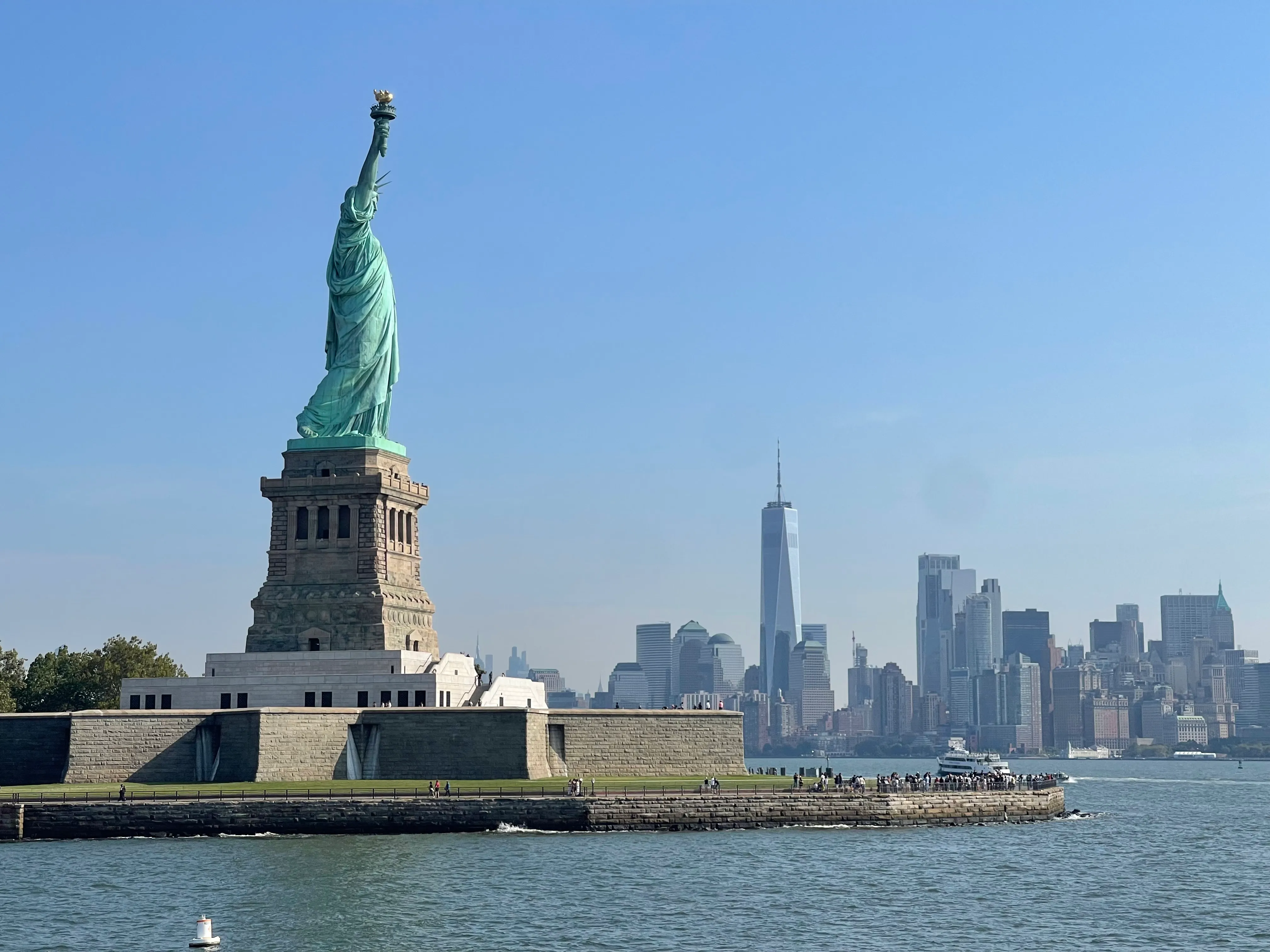
I recently participated in a Socrates in the City retreat in New York City for book-club leaders. Socrates, which hosts live conversations about life’s most pressing topics, invited me this spring to lead its online book club.
What a gift, to meet new friends, hear from Eric Metaxas, who founded SITC in 2000, and gain new insights from the Socrates coordinators and club leaders from around the country. There were sixteen of us, hailing from California, Massachusetts, and spots in between. The goal is to cultivate community and the life of the mind through great and good books. Few aspirations rank higher, given that our technology-saturated culture is starved for community and the truth.
Noah joined me. It was his first trip to the organized chaos of NYC. Tuesday evening, he participated with me in Socrates’s New York City book club in Midtown. Eric Metaxas read chapter 23 from his newest book, Revolution: The Birth of the Greatest Nation in the History of the World. Later, we shared our thoughts with the group. Over dinner, we met new friends, including several from Greece. Toward the end of our trip, I showed Noah NYC highlights. More on that in a separate piece.
Socrates, Revolution, and Education
Metaxas has credited English author and social critic Os Guinness with sparking the idea for SITC, which launched as a way for busy New York professionals to steal away for a few hours and ponder life’s big issues. Technically, Socrates himself could be credited with the group’s origins, because it’s rooted in his famous words: “The unexamined life is not worth living.”
If you’ve watched or listened to a Socrates event, you know that they’re at once riveting and entertaining. The book clubs are a natural extension of those conversations. We explore the beautiful, true, and good, asking questions and sharing insights.
The clubs follow the Just Show Up format, which means all reading is done together at group meetings. We read for around forty minutes and spend the rest in discussion. My group launched with Revolution. It’s been a wonderful primer on the details of America’s founding, and a way to reflect on the current state of our republic.
The book often points out important facts that we didn’t learn in K-12 or college. For instance, not only was John Adams a profound intellect, but something of a prophet. When he wrote a four-part essay on liberty, however, he cloaked his identity under the pen name “Humphrey Ploughjogger,” meaning that few if any readers would’ve attributed the brilliance to Adams.
That brilliance is evident even in his earliest notes for the essays, Metaxas writes: “Adams says that liberty had never in history been ‘enjoyed in its full perfection,’ but then—quite astonishingly—out of the blue declares that it ‘will reign in America, over hundreds and thousands of millions at a time.’ What in the world could explain his saying such a thing in 1765? Nonetheless, in this opening fragment, Adams flatly and confidently prophesies that one day ‘Man shall make his true figure upon this continent,’ which ‘his great Creator intended he should in other countries, before his ruin was effected by the lust of tyrants.’ The soon-to-be father goes further, predicting a coming golden age, in which ‘science, literature, civility, politeness, humanity, [and] every Christian grace and virtue shall be well understood by all men …’ He declares these things on the page, somehow seeming to know that they are on the horizon, that they are nearly at hand. ‘Then,’ he declares, ‘will be the era of human happiness.’” (p. 44)
America is rooted in struggle. Those who settled America were purposeful in their struggle—a purpose which, Metaxas points out, harks back to the Reformation. And as Adams indicated, they prioritized liberty above all: “It was not religion alone, as is commonly supposed,” he says, “but it was a love of universal liberty, and a hatred, a dread, an horror of the infernal confederacy, before described, that projected, conducted, and accomplished the settlement of America.” (p. 46)
Also striking is the colonists’ love of learning. Well-read and adept at critical thinking, they likely received classical-Christian education (CCE), which steeps students in logic and rhetoric and develops critical-thinking skills. CCE focuses on cultivating intellect, wisdom, and above all, noble character. Students develop hearts and minds that seek and defend the truth.
Adams went on to write “that the diffusion of knowledge among the people is central to combating a tyranny of elites,” according to Metaxas. Soon after early Americans arrived in the New World, they set up colleges, universities, and grammar schools. “In other words, there could be no room for ignorance or illiteracy, which the established churches in England and throughout Europe had required to render the people subservient. Reading and understanding the Bible—and the principles arising therefrom—was central to a free people and to liberty.” (p. 48)
From Widespread Knowledge to Illiteracy?
Ignorance breeds subservience. That’s something to consider, given the abysmal performance of modern public schools in both literacy and math. The most recent federal report card on student performance, known as the National Assessment of Educational Progress (NAEP), shows startling numbers of students unable to perform at grade level in both reading and math. For instance, in 2024, about forty percent of fourth-graders and thirty-three percent of eighth-graders couldn’t demonstrate even basic grade-level reading skills.
Among seniors, thirty-two percent failed to achieve that same basic reading threshold, while forty-five percent couldn’t meet the math minimums. What are the implications of these dreary numbers? David Winston, an election analyst and adviser to congressional Republicans and the private sector, explained in an op-ed for Roll Call: “For reading, this means those students who are below Basic are unlikely to be able to make simple inferences about a text, express or support opinions with text-based evidence, or evaluate the effectiveness of an author’s claim. … For math, this means, for example, applying single-step percentages to solve real-world problems. Calculating the discount of an $80 shirt on sale for 10 percent off would likely be beyond many students’ ability.”
Though “college readiness” has been the K-12 mantra for some time, Winston notes that students aren’t just unprepared for college, but also for vocational-technical school. Higher ed must now offer remedial education to provide skills students should’ve mastered in K-12.
“Our K-12 education crisis is more than just an education challenge. It is a threat to the economy, national security and the future of the country. This latest round of NAEP results reinforce that we need a fundamental rethink of our K-12 system,” according to Winston.
The hard-skills deficit doesn’t just plague K-12. It’s common among college graduates, too.
In a 2019 article, historian and classical scholar Victor Davis Hanson said: “Few believe any more that current liberal-arts programs have prepared graduates to write persuasively and elegantly, to read critically and to think inductively while drawing on a wide body of literary, linguistic, historical, artistic, and philosophical knowledge. In fairness, that is no longer the aim of higher education. When students at tony colleges present petitions objecting to free speech or the right of guests to give lectures, they are usually full of grammatical errors and often incoherent.”
Some higher-ed leaders and faculty strive to teach those skills, but they’re a shrinking minority, Hanson wrote.
“By and large, the bachelor’s degree, even in a liberal-arts major, no longer certifies that a graduate will be able to read, reason, compute, or draw on a body of knowledge far more effectively than those without an undergraduate degree. The decline of the university has been an ongoing tragedy since the 1960s, but the erosion has accelerated because of ideological bias and its twin, incompetence,” according to Hanson.
Earlier this year, another historian hinted at how that ideological bias has played out, particularly with the teaching of U.S. history. At Hillsdale College’s spring 2026 convocation, professor Wilfred McClay said, “I sometimes ask some of my fellow historians who write in highly critical ways about the American past whether they ever worry that a relentless emphasis on the negative aspects of their country’s history could ultimately be demoralizing to the young. The answer I hear is nearly always the same: ‘That’s not my job.’ But it’s an inadequate, self-serving answer.”
Republics that don’t train rising generations to be both competent and loyal will falter, McClay said. “An education that refuses to address these things, refuses to situate them on solid ground, an education that blithely declares that such things are ‘not its job,’ will undermine a republic rather than support it,” he said.
America has been traveling a “disastrous educational road,” he said—but we can reverse course. On the 250th anniversary of its independence, the U.S. has the opportunity “to reach back in time and renew ourselves by remembering who we are. Not a people held together by coercion and victimization but held together by a common pursuit of human dignity and faith in the capacity of citizens to govern themselves.”
America’s “Civilizational Moment”
McClay opened his Hillsdale convocation speech by reminding listeners of the importance of understanding history and contemplating the future. He offered British statesman Edmund Burke’s words from Reflections on the Revolution in France: “People will not look forward to posterity who never look backward to their ancestors.”
It’s more important than ever for Americans to look backward and forward, as Burke and McClay urge. Metaxas’s book on the American Revolution and the book clubs that have launched with it are doing just that. The onus falls not just on political leaders, but on every U.S. citizen who abides by the same principles that drove our Founders to fight for independence.
America and Western civilization as a whole are, as Os Guinness said at a SITC event in 2022, in the midst of a “civilizational moment.”
“Every great civilization has a dynamic or an inspiration. And you think, ‘None of great civilizations are around, they’ve gone.’ There’s a moment when the civilization loses touch with what made it. At that point you have only three broad options: renewal, replacement, or decline. The west is there today,” Guinness said.
He argued that many Americans have lost touch with the principles that have enabled our country to flourish. Central among them—and contrary to the current push to “save democracy”—is the fact that the Founders pointedly set up America as a republic. They were wary of pure democracy, Guinness noted, because it results in mob rule.
A love of freedom and liberty has defined America since the beginning. Looking backward, even briefly, reminds us of that. Considering present trends and recent policies, such as those during the Covid-19 pandemic, demonstrates how it doesn’t take much to erase our freedoms and liberties. Guinness noted that Covid-era policies underscored a growing gap between elites and populists, and how America is moving toward becoming an oligarchy. What’s needed, he said, is a homecoming as the Hebrews defined it: a complete turning of heart, mind, and spirit toward the truth of where we began.
In his book, A Free People’s Suicide: Sustainable Freedom and the American Future, Guinness exhorts us to action: “[S]ustainable freedom depends on the character of the rulers and the ruled alike, and on the vital trust between them—both of which are far more than a matter of law. The Constitution, which is the foundational law of the land, should be supported and sustained by faith, character and virtue of the entire citizenry, which comprises its moral constitution, or habits of the heart. Together with the Constitution, these habits of the heart are the real, complete and essential bulwark of American liberty. A republic grounded only in a consensus forged of calculation and competing self-interests can never last.”
The hour is late. Whether our children inherit an intact republic or one in name only depends on our commitment today to looking back, looking ahead, and choosing wisely.
Comments
Loading comments...
Trackbacks & Pingbacks
Leave a Comment