Celebrating Flag Day: Our Banner Yet Waves
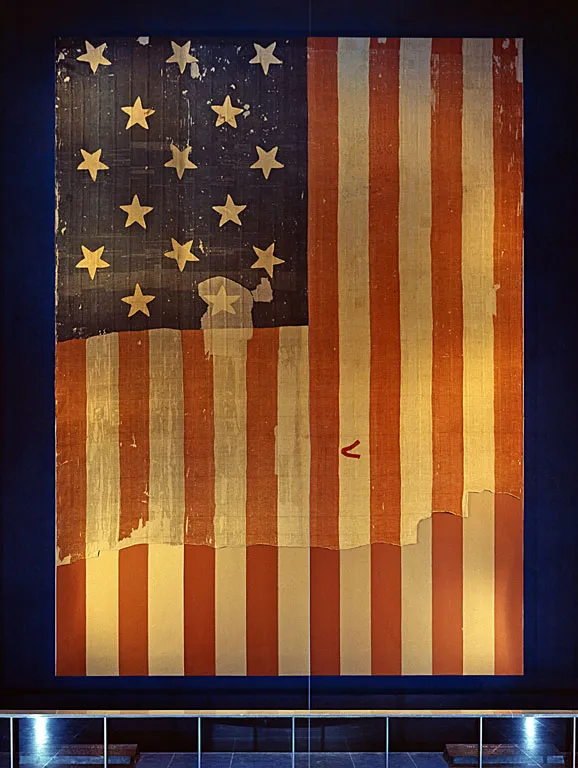
By the time Flag Day rolls around on June 14, most—if not all—American schools are already on summer break. But in the late 1800s, U.S. schools often led Flag Day celebrations and helped establish it as a tradition.
The day is a nod to the Second Continental Congress’s June 14, 1777, resolution that established the design for America’s now-famous stars and stripes. The flag would bear “thirteen stripes, alternate red and white: that the union be thirteen stars, white in a blue field, representing a new constellation.”
While not everyone agrees about when the first Flag Day was celebrated, it rose in prominence during the nineteenth century, according to the History Channel:
“Some sources point to an 1861 commemoration in Hartford, Connecticut, honoring the Union’s strength at the start of the Civil War as the first Flag Day. The next year, the Connecticut General Assembly recognized June 14 as Flag Day.
“A lasting tradition likely didn’t happen until more than 100 years after the flag’s design was approved. Bernard Cigrand, a teacher in a one-room schoolhouse in Wisconsin, organized a lesson plan for June 14, 1885, in honor of the flag’s ‘birthday.’ Many consider this event the first annual observance of Flag Day. Soon, more states began to adopt the tradition, often with schools leading the way.”
The National Archives notes that Cigrand had aimed to spur patriotism by honoring the flag, and the “high point of Cigrand’s campaign came with” President Wilson’s 1916 proclamation recognizing June 14 as Flag Day. World War I was approaching, and Wilson no doubt sought to drum up America’s morale and fortitude. During “another time of international strife” in 1949, President Truman signed a joint resolution of Congress that designated June 14 as Flag Day.
Sadly, not everyone has revered Old Glory. Some refuse to pledge allegiance to it, and others have burned it. And the Supreme Court has upheld an individual’s right to make those choices.
A 1943 Supreme Court decision, West Virginia v. Barnette, ruled that no public school or government can require a student to salute the flag or recite the Pledge of Allegiance. Justice Robert Jackson’s opinion in Barnette says, “If there is any fixed star in our constitutional constellation, it is that no official, high or petty, can prescribe what shall be orthodox in politics, nationalism, religion, or other matters of opinion, or force citizens to confess by word or act their faith therein.”
In 1989, SCOTUS ruled in Texas v. Johnson that the First Amendment protects flag burning because it’s a form of symbolic speech.
The debate over these issues continues. Should we allow everyone, including illegal immigrants and those who spew hatred for America, to burn our flag and snub it in our classrooms? Some say no.
A bill dubbed the Promoting American Patriotism in Our Schools Act would “amend the Elementary and Secondary Education Act of 1965 to require the recitation of the Pledge of Allegiance and the display of the American Flag in certain federally funded elementary and secondary schools.” Introduced in the 119th Congress, the bill has yet to be enacted.
A friend recently mentioned that most of the students in her daughter’s public-school class don’t stand for the daily recitation of the Pledge of Allegiance. That’s ironic, given that our public schools once led Flag Day celebrations, but hardly surprising, given the decay of America’s education system. Federal legislation to promote patriotism among our children would be a good start, but we have much more work to do.
In the meantime, America’s banner still waves. According to the National Flag Foundation, an American flag “on a journey of remembrance” has traveled to every U.S. state and territory, and to all the American cemeteries abroad. Its final stop will be Washington, D.C., in time for the 250th celebration of our independence.
Comments
Loading comments...
Trackbacks & Pingbacks
Leave a Comment