Michelangelo: The Sculptor Who Reshaped the Art World Forever
It pays to break the rules.
In the art world, no one better illustrated that than Michelangelo Buonarroti. An outlier who defied rules and norms, he changed art forever, a point underscored in Michelangelo and the Pope’s Ceiling by Ross King.
King brings to life Michelangelo and his contemporary, Raphael (formally, Raffaello Santi), juxtaposing the two. While Michelangelo was known for being antisocial, slovenly, and something of a malcontent, the affable Raphael acquired friends with his generous, polite, gentle demeanor. Ultimately, King’s comparison illuminates Michelangelo’s genius:
One way to understand the differing styles of the two artists is through a pair of aesthetic categories developed two and a half centuries later by the Irish statesman and writer Edmund Burke in his Philosophical Enquiry into the Origin of Our Ideas of the Sublime and Beautiful, published in 1756. For Burke, those things we call beautiful have the properties of smoothness, delicacy, softness of color, and elegance of movement. The sublime, on the other hand, comprehends the vast, the obscure, the powerful, the rugged, the difficult—attributes which produce in the spectator a kind of astonished wonder and even terror. For the people of Rome in 1511, Raphael was beautiful but Michelangelo sublime.
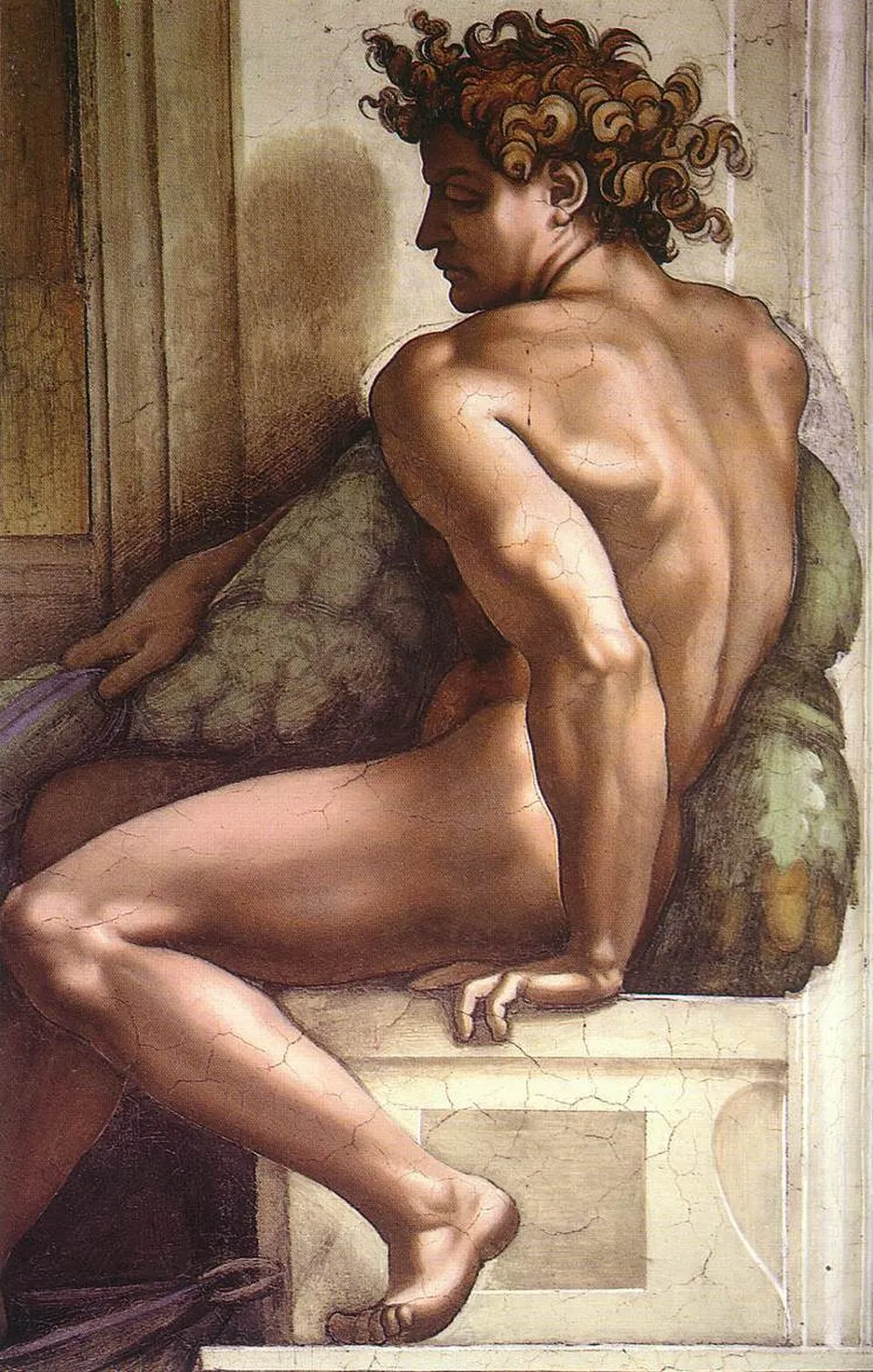
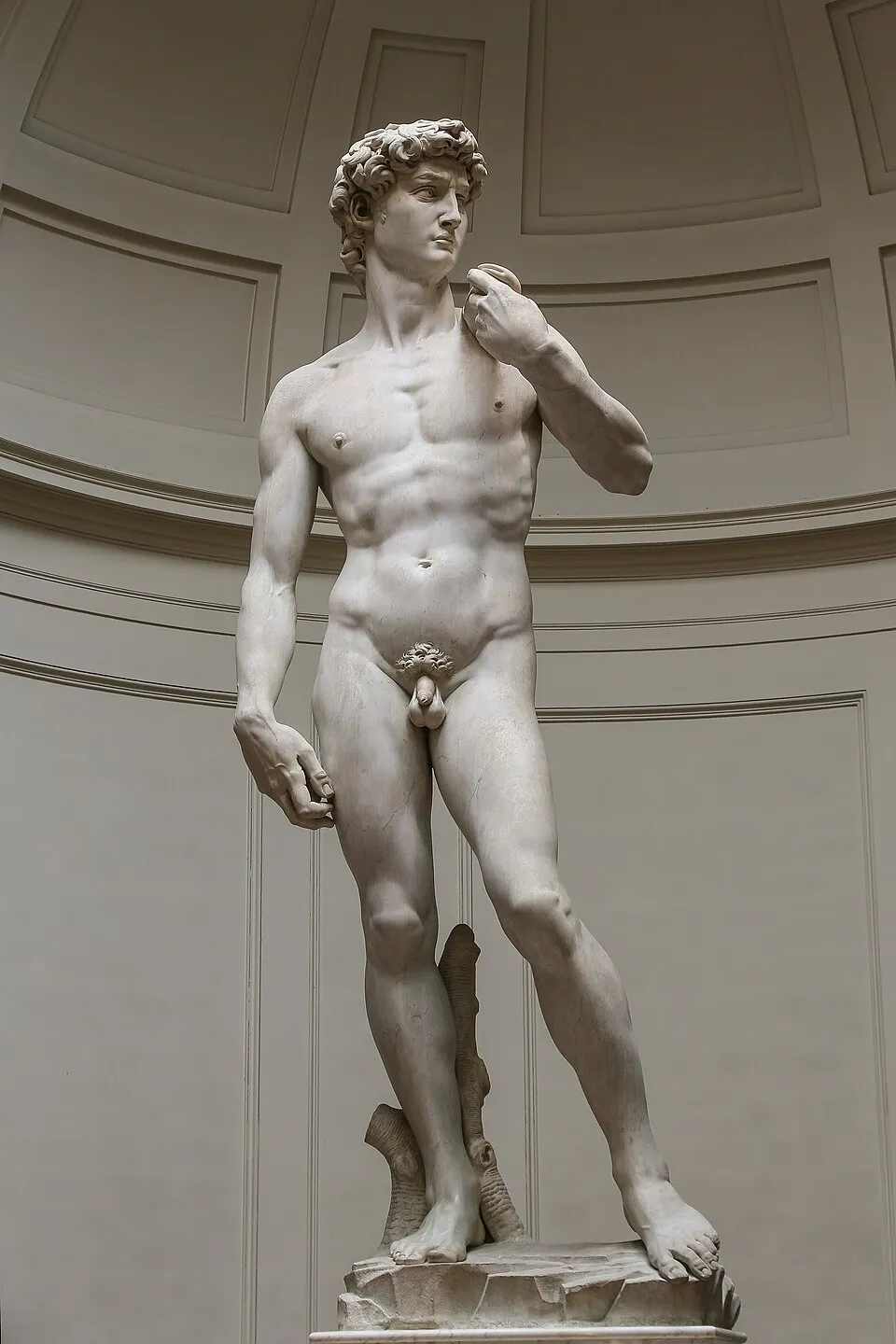
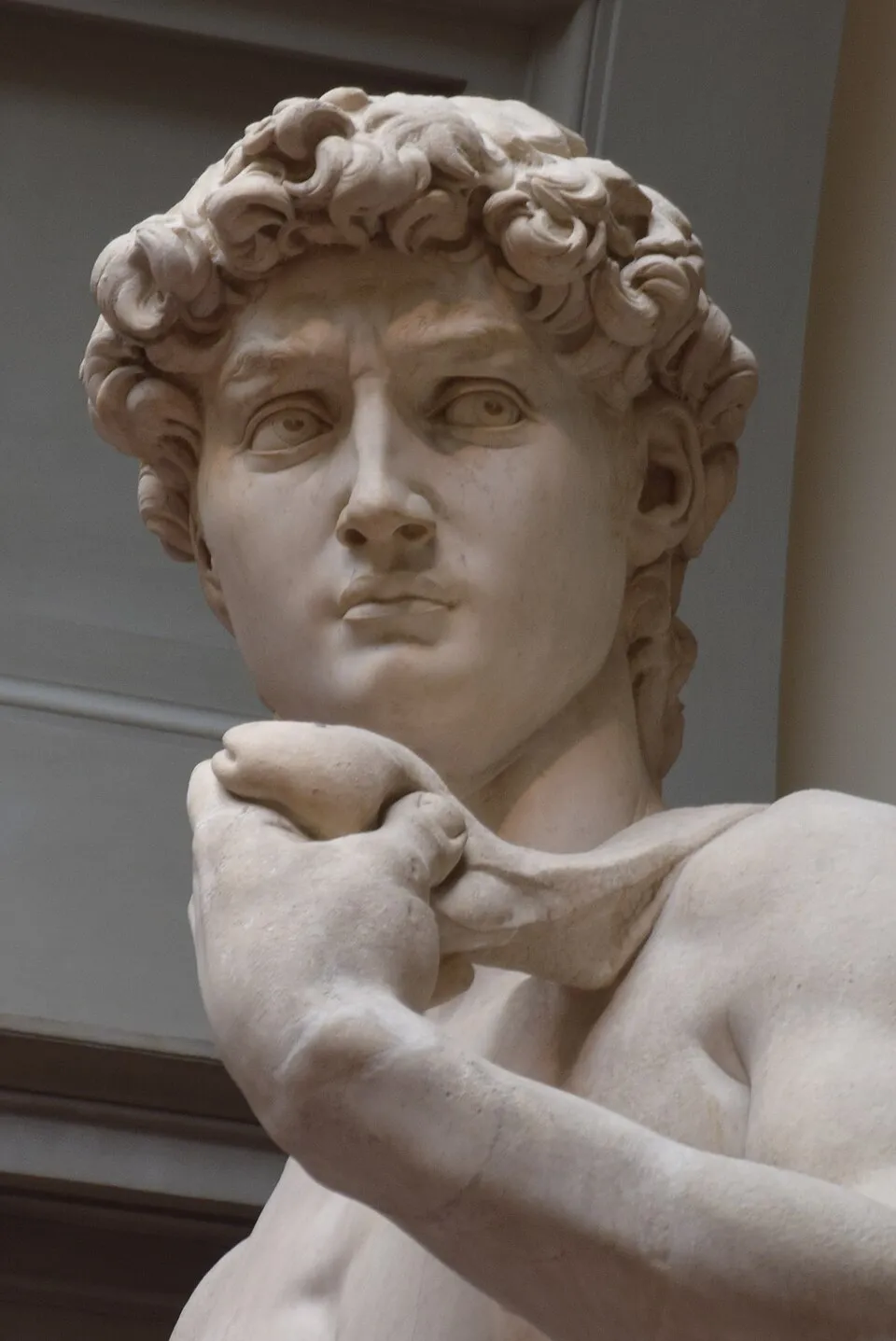
Raphael recognized this difference more astutely than anyone. … how Michelangelo’s work in the Sistine Chapel marked an entirely new direction. Especially in his prophets, sibyls, and ignudi, Michelangelo had brought the power, vitality, and sheer magnitude of works of sculpture such as the David into the realm of painting. The art of fresco would never be the same again.
Four Years of Challenges
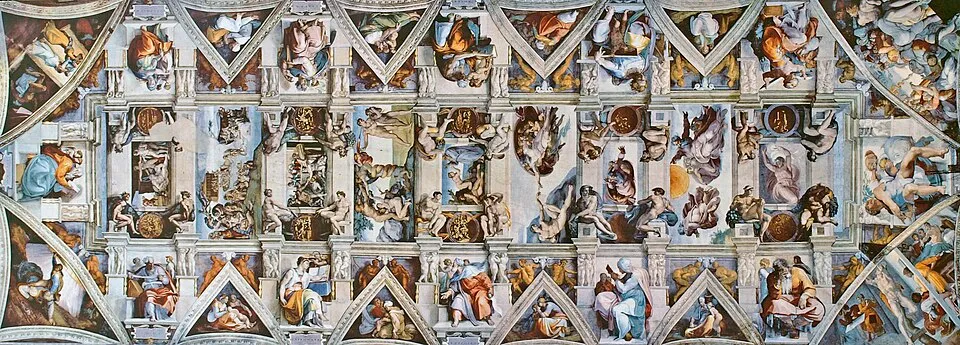
Pope Julius II commissioned the artist to paint the vault of the Sistine Chapel in 1508. The pope’s original vision involved painting the Twelve Apostles above the chapel’s windows and covering the rest of the space with a mesh of squares and circles. According to Michelangelo, when he objected to the design, Julius agreed to let him chart his own course.
With a blank slate—ceiling, rather—before him, what hurdles did the artist face?
Although Michelangelo was known for delivering monolithic works of art, he had little experience painting frescoes. The Sistine ceiling was 12,000 square feet of uneven surfaces, curved or flat, large or small, and some were awkward. They were divided into three types:
- Four pendentives: “large, sail-shaped fields” in the chapel’s corners
- Eight spandrels: triangular areas over the windows
- Sixteen lunettes: crescent shapes at the highest points of the four walls
Not to be deterred, Michelangelo devised an “imaginary architectural background” that viewers from the floor would see as “rich sculptural decoration.” This solution integrated the three surface types and furnished separate fields for the artist’s scenes. Michelangelo derived the ceiling’s subjects from the Old Testament, the genealogy of Christ, and the classical sibyls whom Christian tradition pointed to as prophets of His coming.
“One of the largest assemblies of images ever planned, it would ultimately involve more than 150 separate pictorial units and include more than three hundred individual figures,” King writes. Decidedly more rigorous than the pope’s suggestion, Michelangelo’s plan “would pose an enormous challenge” that took four years to finish.
To boot, frescoing, or painting on wet plaster, was notoriously difficult to execute well. King explains that it demanded “both good preparation and precise timing. A layer of plaster, known as the intonaco, was troweled to a thickness of about a half inch over another coat of dried plaster. Intonaco, a smooth paste made from lime and sand, provided a permeable surface for the pigments, first absorbing them and then sealing them in the masonry as it dried. …
“Ingenious the technique may have been, but the potential for disaster dogged the painter’s every step. One major problem concerned the time available to paint the intonaco, which stayed wet, depending on the weather, for no more than twelve to twenty-four hours. Since after this period the plaster no longer absorbed the pigments, it was laid down only in an area that the frescoist could complete in a single day, known as a giornata (day’s work). The large surface of a wall or vault would therefore be divided into anything from a dozen to several hundred of these giornate.”
“I’m No Painter”
Though Michelangelo’s Sistine frescoes often are heralded as one of the world’s greatest works of art, he didn’t consider himself much of a painter. About a year into frescoing (1509), he sent a poem of lament—albeit a comical one, King notes—to his friend, Giovanni da Pistoia:
I’ve got myself a goiter from this strain, … My beard toward Heaven, I feel the back of my brain Upon my neck, … My brush, above my face continually, Makes it a splendid floor by dripping down. … Giovanni, come to the rescue Of my dead painting now, and of my honor; I’m not in a good place, and I’m no painter.
The irony of the last line is perhaps most pronounced for those who see the Sistine Chapel ceiling in person, especially for the first time. It defies words. If Michelangelo wasn’t a painter, who is?
The back story, of course, helps make sense of it. Michelangelo’s identity was tied to sculpting. King writes that he was “almost as renowned for his moody temper and aloof, suspicious nature as he was for his amazing skill with the hammer and chisel.”
Two sculptures, the Pietà and the David, solidified his prowess well before he started work on the Sistine vault. Michelangelo was in his early twenties when he sculpted the Pietà from 1498-1499, and twenty-nine when his David was placed at the front of Florence’s Palazzo della Signoria.
Michelangelo initially refused the Pope’s assignment and fled Rome. He had little painting experience and hadn’t mastered di sotto in sù, a specialized form of foreshortening used to depict figures as if seen from directly below. This technique created the illusion of figures hovering above the viewer on the towering, curved surfaces of vaults. Michelangelo considered the Sistine job far less prestigious than sculpting the pope’s tomb, the project for which he originally was called to Rome, because chapel ceilings typically were assigned to assistants or artists not as well-known.
Meanwhile, according to two of the artist’s biographers, Ascanio Condivi and Giorgio Vasari, those envious of Michelangelo tried to use the commission to sabotage his career. One purported saboteur was architect Donato d’Angelo Lazzari, called Bramante. “Bramante anticipated that Michelangelo would either refuse the Sistine commission, and in so doing incur the ire of the pope, or else fail miserably in his attempt through lack of experience. In either case, he would drastically undermine both his reputation and his position at the papal court in Rome,” King writes.
King notes that a master mason from Florence, Piero Rosselli, claimed in a letter to Michelangelo that Bramante had argued against the pope awarding him the commission. “I believe he does not have enough courage and spirit for it, because he has not done too many figures and, above all, the figures are high and in foreshortening, and this is another thing from painting at ground level.” As outliers tend to do, Michelangelo would prove his critics wrong.
When the first half of the finished ceiling was unveiled on August 15, 1511, it drew throngs of spectators who delighted in what Condivi called the “new and wonderful manner of painting.” Raphael was utterly moved by what he saw and sought to land the commission to finish the vault, based on Condivi’s accounts. Those efforts failed.
“An Almost Impossible Standard”
Michelangelo changed his approach after the unveiling, opting to fill the second half of the panels with fewer, larger figures. He first executed this altered tactic in The Creation of Adam, arguably the most famous ceiling fresco. The looming Adam is reminiscent of a sculpture. Vasari compared it to a re-enactment of creation itself, not simply to a version of it. “Higher praise is difficult to imagine, but then the opening premise of Vasari’s biography is that Michelangelo was God’s representative on Earth, sent down from Heaven to show humankind ‘the perfection of the art of design,’” according to King.
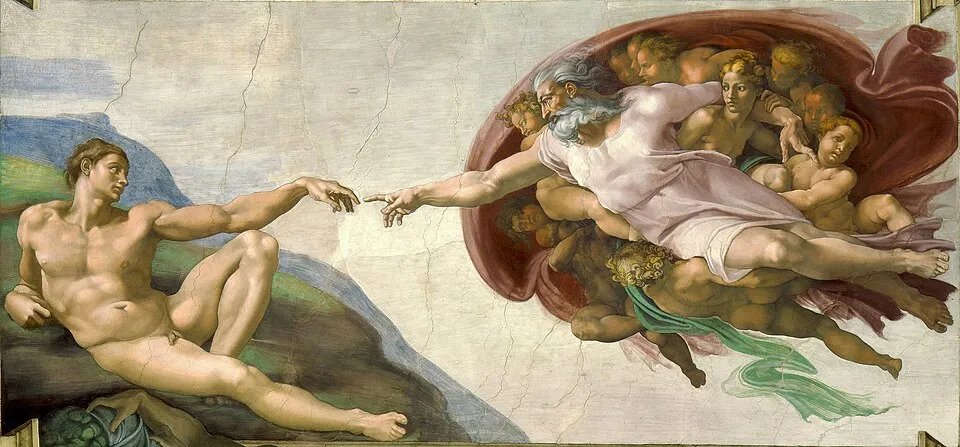
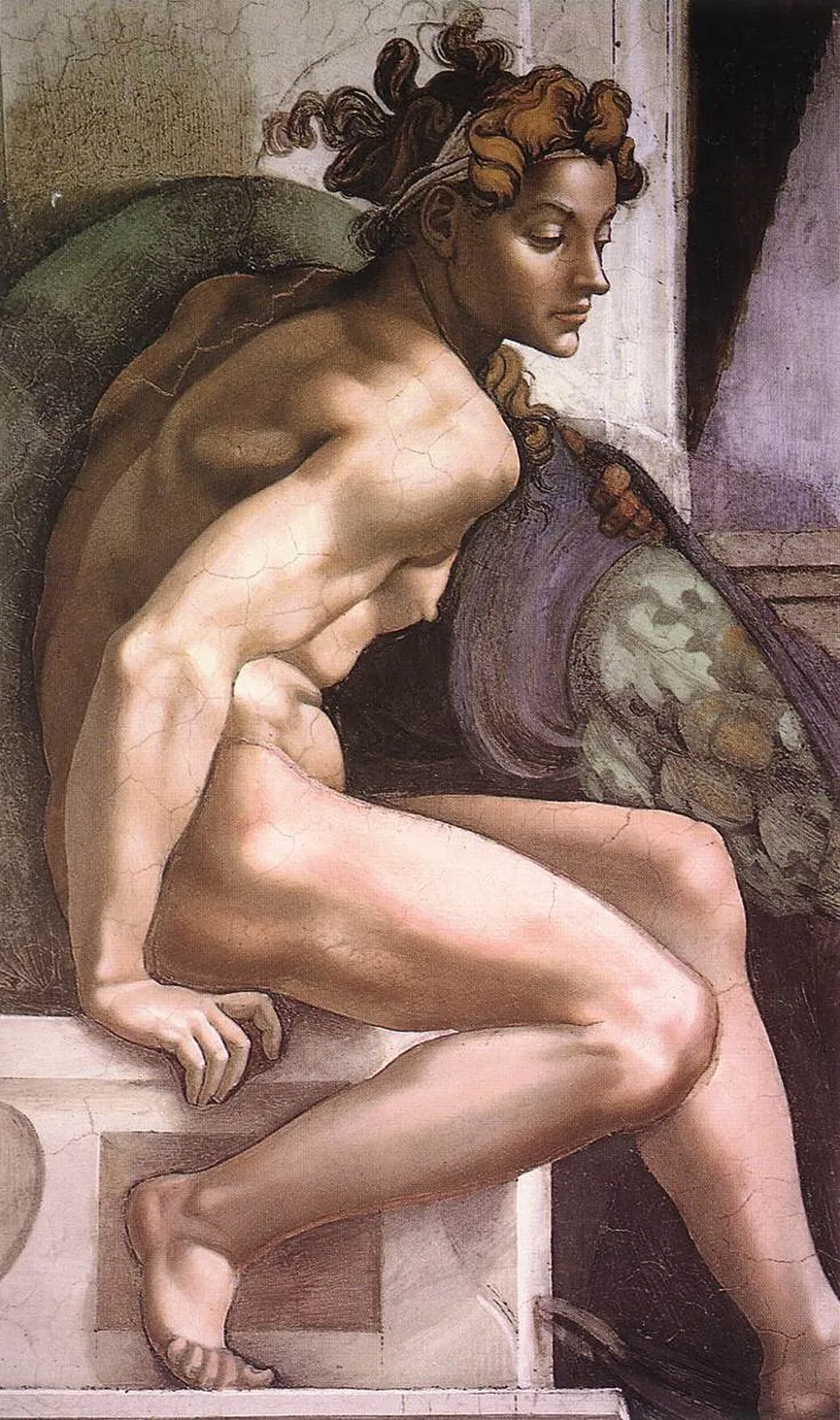
Adam resembled the ignudi, the twenty muscular, male nudes lining the vault. In particular, King says, the last pairs of ignudi cemented Michelangelo’s reputation as a revolutionary. “They revealed a stunning virtuosity that pushed the limits of both human anatomy and artistic form. Never before, in either marble or paint, had the expressive possibilities of the human form been detailed with such astonishing invention and aplomb. … If the male nude was the genre in which, by 1512, all artists were forced to test themselves, Michelangelo’s final few ignudi set an almost impossible standard.”
Jonah: A Triumph in Foreshortening
One of Michelangelo’s Sistine prophets, Jonah, keenly displays the artist’s familiarity with scripture and his technical brilliance. Some, like Condivi, have pointed to Jonah as the most gloriously executed of all the vault’s figures. The art historian Richard Stemp notes Condivi’s sentiments about the prophets and the sibyls:
But marvellous beyond all of them is the Prophet Jonah, placed at the head of the vault. This is for the reason that against the plane of this vault and through the power of light and shadow, the torso, which is foreshortened to recede inwards, is in the part which is nearer to the eye, and the legs which project forwards are in the part farther away. A stupendous work, and one which makes clear how much knowledge this man had of principles and the use of line in creating foreshortenings and perspectives.
King notes that Jonah appears to be Michelangelo’s “triumphant reply” to the doubting Bramante, who had believed him to be the wrong man for the Sistine commission.
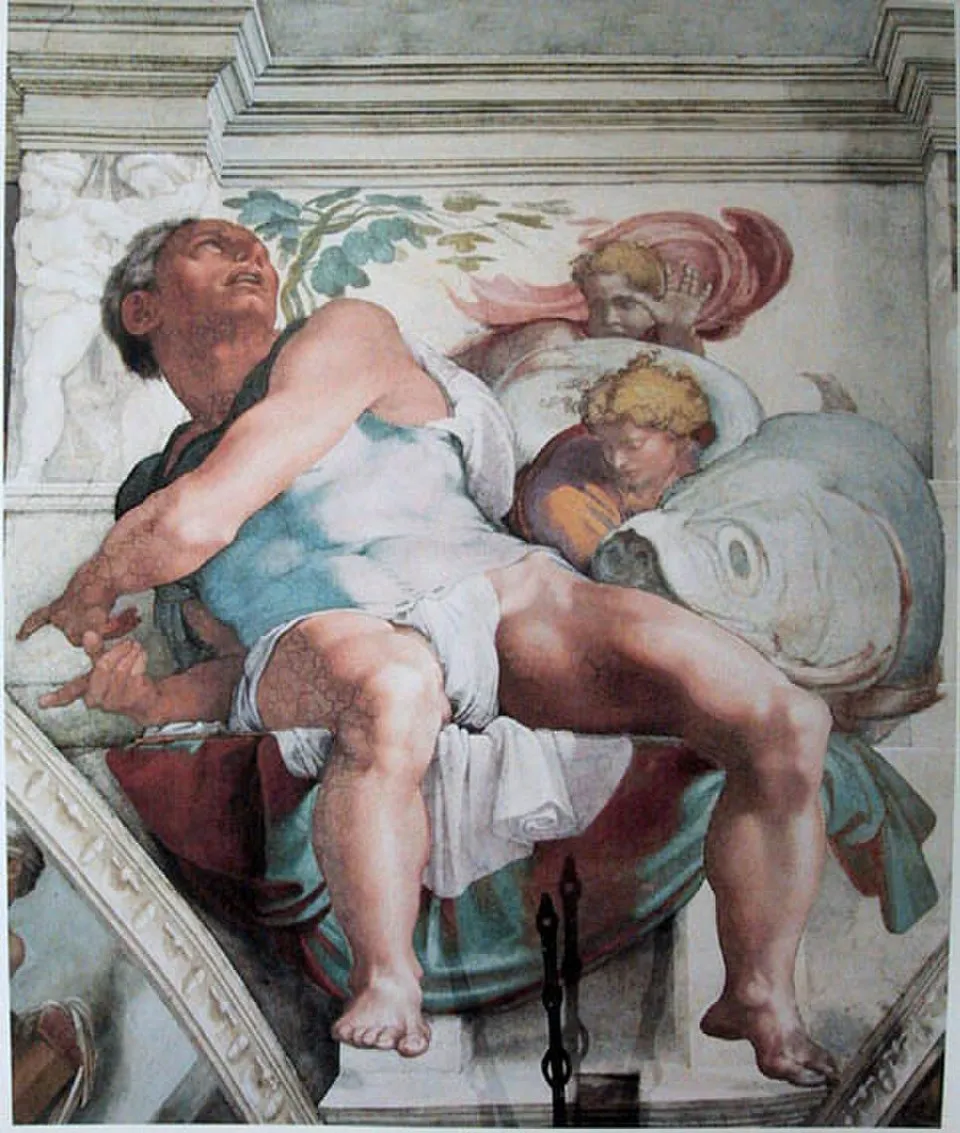
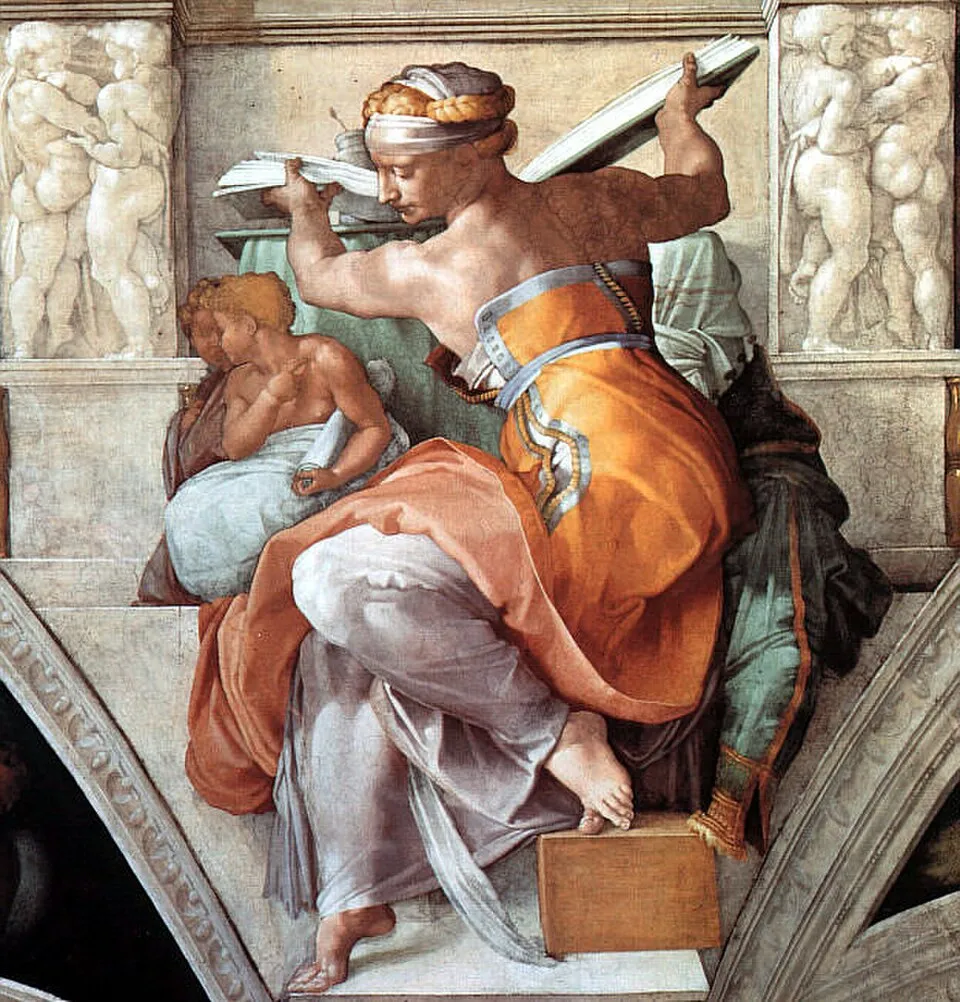
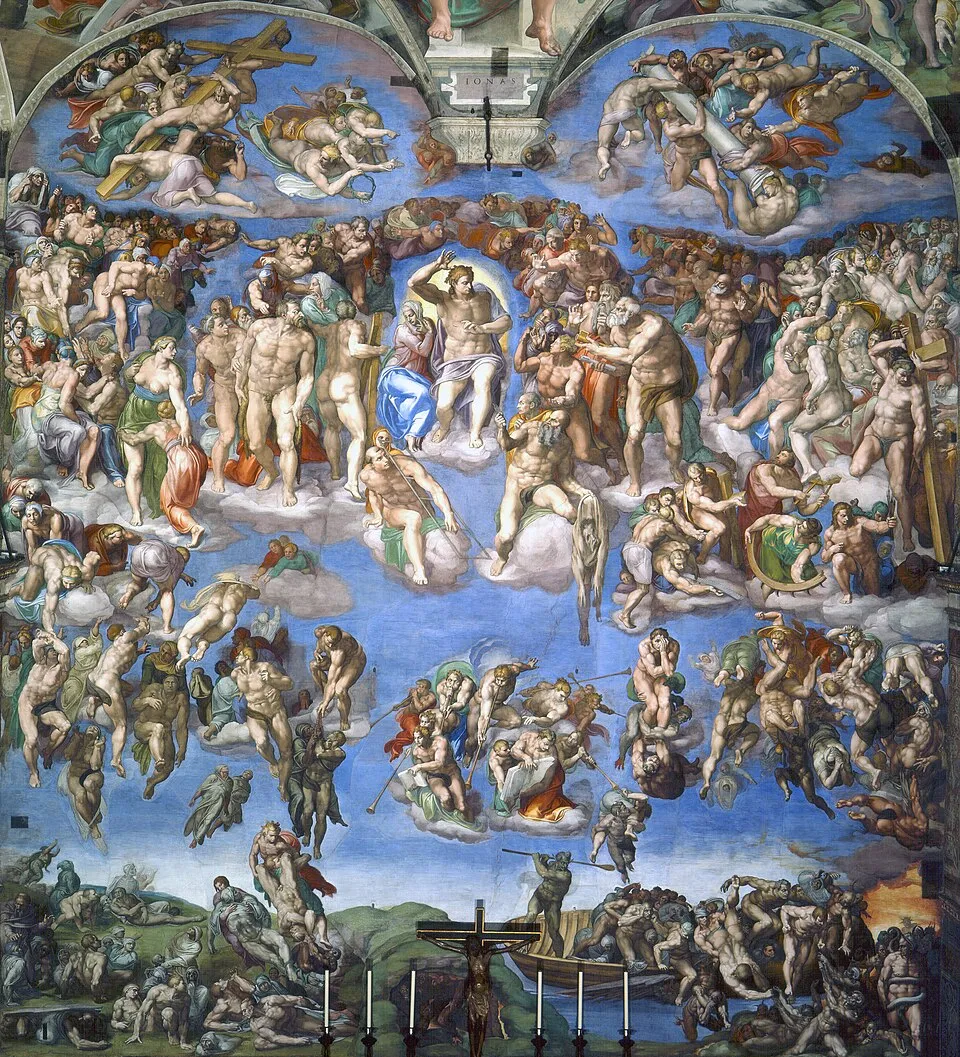
Jonah’s location, directly above the altar and Jesus in The Last Judgment and beneath God, is key, according to Stemp. “It could even be that, rather than leaning back, Jonah is in the process of sitting up, a physical action expressive of resurrection, having been ‘vomited … upon the dry land’. In terms of his position in the chapel, he is looking up towards God the Father dividing night and day on the ceiling, and appears to be pointing down to the forgiving Ahasuerus—so we have death, resurrection and forgiveness, night and day. … Michelangelo uses this figure of Jonah leaning back to look forward to the Crucifixion, to Christ’s death and resurrection, thus making it symbolically more present.”
Michelangelo likely tapped Jonah as his “spectator,” a term coined by Leon Battista Alberti, according to King. Embedded in an artwork, a spectator leads viewers’ eyes and emotions in one direction or another with his or her body language. “Michelangelo seems to have taken Alberti’s advice, since Jonah both directs the gazes of worshipers entering the chapel from the Sala Regia and pantomimes their reared-back stances and awestruck faces as they gaze at the magnificent fresco above their heads,” King writes.
A true outlier, Michelangelo brought a sculptor’s keen eye for form to frescoing, an art form largely foreign to him. The combination proved magical. Undeterred by a variety of physical, technical, and situational constraints, he created a new standard in art. Michelangelo didn’t just break the rules. He rewrote them, and posterity continues to benefit.
Sources:
Comments
Loading comments...
Trackbacks & Pingbacks
Leave a Comment