Making Sure Tomorrow's America Never Forgets 9/11
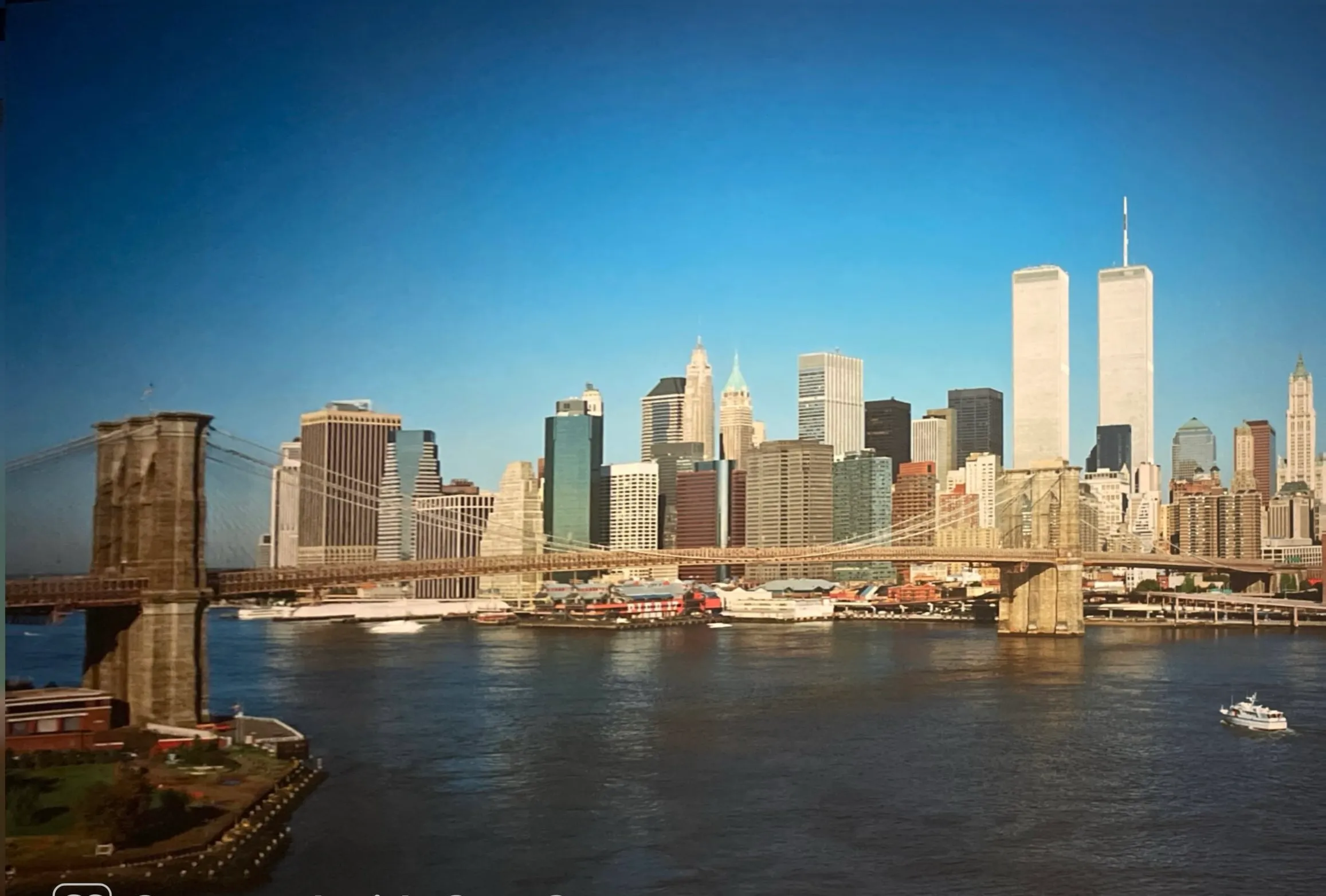
It’s been twenty-five years since nineteen Islamic terrorists slammed jetliners into the heart of America’s financial and military centers. Were it not for the heroic passengers aboard Flight 93, they likely would’ve taken out the U.S. Capitol. In our post-truth era, it’s more important than ever to accurately recount what happened that infamous Tuesday—and why.
It wasn’t just Americans murdered on September 11. The terrorists slaughtered citizens of seventy-eight countries. The destruction in New York alone was worth about sixty billion dollars. Among the dead in Manhattan, 343 were firefighters, 23 were police officers, and 37 were Port Authority officers. Eight children, between the ages of two and eleven, died on the planes.
Words are a poor substitute for many aspects of that day, chief among them the people forced out of the towers by jumping to their deaths. Almost all were from the North Tower, which was struck first but fell after the South Tower, according to a 2002 piece by USA Today, which said extreme smoke and heat spurred their decision: “Within minutes, it would have been very difficult to breathe. That drove people to the windows 1,100 to 1,300 feet above ground.”
If words fail to describe 9/11, pictures come closer. One such image by AP photographer Richard Drew defined the day for some but was rejected by others. A 2003 Esquire story by Tom Junod, “The Falling Man,” focused on the importance of that picture and its place in historical memory. “Some people who look at the picture see stoicism, willpower, a portrait of resignation; others see something else—something discordant and therefore terrible: freedom,” Junod wrote. Most of the newspapers that published the photograph did so only once, he said, after fielding complaints that they had exploited the man’s death.
More than a third of U.S. residents alive today have no memory of 9/11, and 103 million weren’t yet born. For those born after the attacks, “connecting to 9/11 is a struggle between history and current events,” according to a piece in U.S. News & World Report.
A study by the Association for the Study of the Middle East and Africa found that two-thirds of professors who teach about the Middle East “felt strongly that their students could not correctly identify the reasons behind the attack or its perpetrators. Even more disturbingly, a mere four percent of respondents expressed complete confidence in their students’ knowledge of the causes leading up to 9/11 or their ability to grasp the event’s key facts.” Meanwhile, 71 percent of those faculty believe American academia is worse equipped today “to pursue truth-seeking as its central mission” than it was on 9/11.
As some have rightly noted, we owe it to these rising generations and to the victims of 9/11 to maintain clarity about that day: the terrorists, including the man behind them, Osama bin Laden, were responsible for the evil unleashed on thousands of innocents. Those innocents, including firefighters, other first responders, 9-1-1 dispatchers, the people who helped each other escape the towers and the Pentagon, and the Flight 93 passengers—they were the heroes, doing as much good as they could despite the jaws of hell vying to devour them.
All Americans—especially our elected leaders and wayward Fourth Estate—must reckon with the reality that religion and culture were the root causes of 9/11. Ayaan Hirsi Ali, a research fellow at Stanford University’s Hoover Institution; John Daniel Davidson, a senior editor at the Federalist; and Kristen Ziccarelli, a contributor to the Daily Signal, argue that ignoring this reality threatens the future of Western civilization.
Rooting Out the Causes
Both Osama bin Laden, who organized and funded the attacks, and Mohamed Atta, the ringleader of the hijackers, clearly pointed to their religious beliefs as the impetus. In his 2002 “Letter to America,” bin Laden said that above all he sought to convert America to Islam.
Ziccarelli points to a 2016 article in Dabiq, an ISIS propaganda magazine, which also prioritized Westerners’ “disbelief” in Islam. “ISIS, which grew out of al-Qaeda, explicitly rejected the proposition that jihadist hostility toward the West was primarily a response to American foreign policy. It vividly defined disbelief in Islam as the primary reason for its hatred of Westerners and argued that this hatred would persist even if Western military intervention ceased,” she writes.
Yet “almost no one in the West wanted to acknowledge this reality and its implications, because doing so would undermine the animating idea of the post–Cold War project. If sincere religious convictions could inspire Muslims in the 21st century to carry out attacks like 9/11, then it wasn’t really true that all religions are the same. And if that’s the case, then all peoples and cultures are also not the same, and neither is all labor, and suddenly the entire agenda of creating a borderless world of global free markets is called into question,” Davidson writes.
Hirsi Ali notes that Western elites likewise ruled out culture. “Saying that cultural differences exist and should be respected was a foundation of the multicultural order; the idea that some cultures might lead people to murder each other, for reasons that do not appear in the Western rationalist list of sane causes, struck many Western liberals as too close to racism to bother arguing the point.”
Our leaders have gone to great lengths to underscore that terrorists don’t represent Islam. Soon after 9/11, then president George W. Bush said Islam was a peaceful religion. He did launch a successful effort to rout terrorist plots and networks. That mission, upheld by successive administrations, has prevented another large-scale attack on U.S. soil. But as the number of Muslim immigrants has climbed, a widespread failure to acknowledge that not all cultures and religions are compatible with Western civilization is now impossible to ignore.
“[W]e began importing Muslims from far-flung countries in record numbers—people from the same countries that had celebrated and danced in the streets when the towers fell. Pew Research estimates the number of Muslims in the U.S. grew from 2.4 million in 2007, the first time it performed such a tabulation, to 5.5 million today (likely a low estimate). The number of mosques also has increased during those years, from an estimated 1,200 to 2,800,” Davidson notes.
Through immigration, Hirsi Ali notes, the Islamist movement pursues “institutional capture and demographic transformation”—tactics on a par with its terrorist attacks. “This habit of denial is particularly acute among Americans on both the left and the right, who have convinced themselves that Muslim immigration and deliberate infiltration of institutions in order to spread their beliefs and normalize their practices, many of which seek to limit or destroy the freedoms on which Western societies are built, is strictly a European problem. What’s happening in America, they tell me, is not dramatic enough to warrant any kind of serious change. Muslim communities have a constitutional right to grow and expand, and if they win elections then they win elections. What I hear is the same inability that I heard in Europe 25 years ago to accept the magnitude of the threat posed by a hostile foe, or even to admit the reality of cultural differences,” she writes.
A Way Forward
Davidson rightly notes that acknowledging these realities means that “half the country will call you racist.” Hirsi Ali calls on U.S. leaders to recognize that Islamism is “not only a violent security problem but also a civilizational project; that hybrid state adversaries exploit the same liberal openings that Islamists do; and that domestic polarization and mass migration from Muslim countries magnifies [sic] all of these risks.” She recommends identifying, regulating, dismantling, or prohibiting “Islamist-linked infrastructures” aligned with “long-term civilizational projects.”
Taking such steps would establish what she calls civilizational resilience. “It is the hard capacity of a people to see its vulnerabilities clearly, repair them in time, and deny its enemies the use of its virtues as weapons,” Hirsi Ali writes. “To do that, it is important for us to acknowledge that our virtues are real, and uniquely our own—so much so that millions of men have fought and died over centuries to make them real and widely shared. We did not fight those battles because all cultures are the same, or all values are equal. Rather, our ancestors, real and imagined, sacrificed on a civilization-wide scale, so that men and women of all races and backgrounds could think and live freely, according to the dictates of one’s own conscience. Those who share our foundational values belong among us; those who deny the primacy of those values have every right to pursue their own versions of happiness elsewhere.”
During a recent address in Greece, Secretary of State Marco Rubio underscored the foundational values that distinguish the West from other cultures. “Our heroes, the heroes of the West are those who choose to remain faithful to their duty precisely when it is most difficult and painful to do so: the man who is bound by his word, the soldier who will not abandon his post, the captain, the proverbial captain, who goes down with his ship. This is wholly different from what we see, even now, for example from fanatics like the radical mullahs of Iran, whose cult of death hails child suicide bombers as national heroes, and portrays martyrdom as an end to itself,” Rubio said. “Our heroes—our heroes may be willing to die for their cause; but our heroes do not worship death. It is precisely because we value life that we come to recognize the heroism in those who would sooner sacrifice it than to betray their principles. Now, we take the West’s conception of these things—heroism, honor, duty—we take these things for granted. We assume that these somehow are universal to all people in all times and in all places. They are not. They are the product of a distinct character, a distinct character which arose here and shaped the whole story of the civilization that came after it. A civilization that we must fight to defend today with the same passion as our forefathers did.”
What We Owe the Next Generation
Shortly after the twenty-fifth anniversary of 9/11, my son and I visited the September 11 Memorial and Museum. Because he’s one of the millions not yet born on that day, I’ve sought to educate him about it through stories, documentaries, and my first-person accounts as a reporter in the D.C. area. Two things he particularly responded to were the museum’s watercolor mosaic and the twin pools occupying the footprints of the North and South Towers.
The mosaic’s 2,983 watercolor squares are rendered in different shades of blue, one for each victim of the 2001 and 1993 attacks. In the center is a quotation from Virgil’s Aeneid: “No Day Shall Erase You from the Memory of Time.” Among the names etched into the pools, my son recognized several, including Todd Beamer from Flight 93 and Asia Cottom, a sixth grader aboard Flight 77. Though he didn’t live through 9/11, he has built some historical memory of it.
We lost 2,977 people on 9/11. Representatives for more than 9,000 people who died after the attacks have filed claims with the September 11th Victim Compensation Fund (VCF). Of those deaths, the VCF has formally attributed more than 6,000 to 9/11-related illnesses. It’s in their honor that we preserve the historical memory of 9/11. If our colleges and universities won’t teach the truth about why it happened, and if our leaders turn a blind eye to it, we must not. Our commitment to the truth will determine the future our children inherit.
Comments
Loading comments...
Trackbacks & Pingbacks
Leave a Comment