The Declaration as Allegory
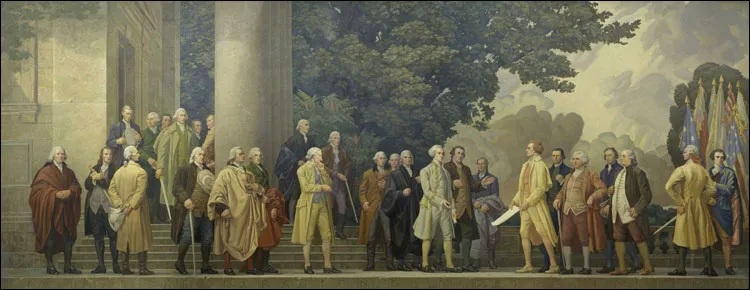
The National Archives boasts two exceptional works of art that hang as crowns above the Declaration of Independence and the Constitution. Created by artist Barry Faulkner between 1935 and 1936, the oil-on-canvas paintings are allegories for America’s most prized documents. Each mural is a monolith, measuring 14 feet by 37.5 feet.
In the Declaration mural, Thomas Jefferson hands the document to John Hancock, president of the Continental Congress. Of the fifty-six signers, twenty-six are shown.
Faulkner submitted many preliminary sketches to the U.S. Commission on Fine Arts. In his penultimate submission, he explained that “the Declaration symbolized war, the Constitution, peace.”
Interestingly, Faulkner painted Lincoln’s sideways profile as a storm cloud behind the central figures. “The Lincoln image extends the historical period into the Civil War, making the murals better serve as frontispieces for the contents of the Archives building,” according to an Archives article by Lester S. Gorelic.
Comments
Loading comments...
Trackbacks & Pingbacks
Leave a Comment